Mocked environments hide the failures that surface when agents touch real dependencies, tests, latency, and permissions. Runloop gives post-training teams one execution layer for three workloads: RL rollouts, SFT data generation, and verified trajectory generation. Each rollout runs in an isolated sandbox provisioned from a reproducible Blueprint, executes against production-like dependencies, and returns structured outcomes your training pipeline can consume.
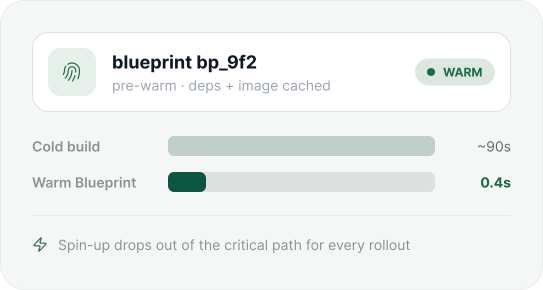
Provision from pre-warmed Blueprints so environment startup isn't the bottleneck in latency-sensitive loops. For many workloads, round-trip time is dominated by model generation and test execution rather than sandbox spin-up.
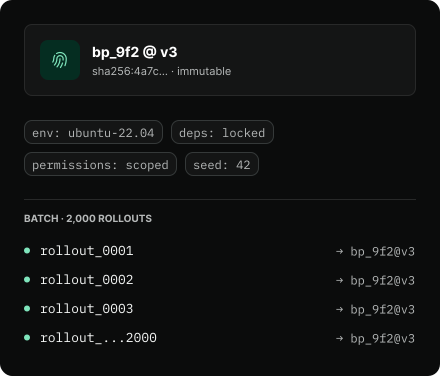
Pin an immutable Blueprint so every rollout in a batch starts from the same environment, dependencies, permissions, and seed state.
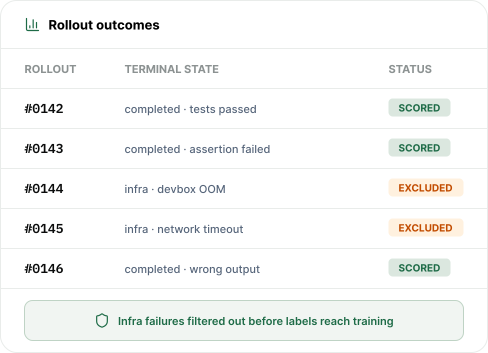
Every rollout returns its terminal state and failure reason, so you can filter infrastructure failures out of your training labels instead of scoring them as model failures.
Runloop executes each rollout in an isolated sandbox and returns execution-verified outcomes from the validator suite, with sub-second provisioning from warm Blueprints. The training loop learns from production-like environments instead of stubs.
Runloop runs thousands of concurrent sessions to generate verified (task, trajectory, outcome) records in hours. Outcomes are labeled by execution rather than annotators, and failure trajectories become training data you can inspect, filter, and feed back into SFT or RL pipelines.
Runloop gives teams the execution layer for post-training, so they don't have to build and maintain their own sandbox fleet, environment versioning, credential scoping, and rollout infrastructure. One layer serves RL, SFT, and trajectory generation across multiple models and customer-specific environments.
We’re dedicated to solving the complex challenges of productionizing AI for software engineering at scale.
Runloop pins an immutable Blueprint so every rollout in a batch starts from the same environment, dependencies, and permissions. Reproducibility is enforced by pinning the exact environment rather than by convention, so a rollout can be rerun or audited against an identical starting point. Differences in outcome are due to the model and the task, not to environmental drift.
Runloop runs 10,000+ concurrent sandbox sessions per batch run. Each session is independently isolated and provisioned from the same Blueprint, so a single batch can generate verified trajectories at scale without teams managing the underlying fleet. This is what lets a post-training run produce thousands of labeled records in hours rather than days.
Runloop provisions a sandbox in under one second from a warm Blueprint. Environment startup is pre-warmed, so spin-up is not the bottleneck in latency-sensitive loops, and for many workloads round-trip time is dominated by model generation and test execution rather than sandbox provisioning. That keeps the rollout loop bound by the work that matters, not by infrastructure overhead.
Runloop returns a terminal state and a failure reason for every rollout, allowing infrastructure failures to be separated from model failures. Boot errors, timeouts, and dependency-install failures each have their own failure reason, so you can filter them out of your labels instead of scoring them as the model getting the task wrong. The result is a cleaner reward signal and fewer mislabeled negatives in the training set.
Runloop labels outcomes by execution rather than annotation. Each rollout runs against a validator suite and returns a structured terminal state, so the reward signal comes from whether the code actually ran and passed, not from a human judgment after the fact. This lets post-training teams generate verified (task, trajectory, outcome) records in hours, rather than routing trajectories through manual review.
Runloop runs each RL rollout in an isolated sandbox that executes against production-like dependencies and returns execution-verified outcomes. Mocked environments hide the failures that only surface when an agent hits real tests, real latency, and real permissions, so Runloop scores outcomes from actual execution rather than stubs. The training loop learns from what the agent did, not from a simulated approximation.