Production data analysis agents need more than a chat loop and a function call. They work the dataset in cycles: load, transform, fit, compare, refine, render. Stateless runtimes force agents to rebuild the same environment each time, making analysis slower, more brittle, and harder to reproduce. Runloop gives each agent a dedicated Devbox that holds state across the loop, so the agent keeps its working context and produces faster, more reproducible analysis.
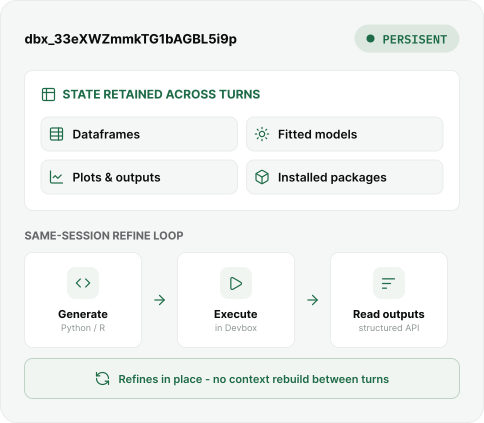
Each session gets a dedicated Devbox with a persistent filesystem, environment, and installed packages. The agent generates Python or R, executes it in the Devbox, reads structured outputs back through the API, and refines within the same session.
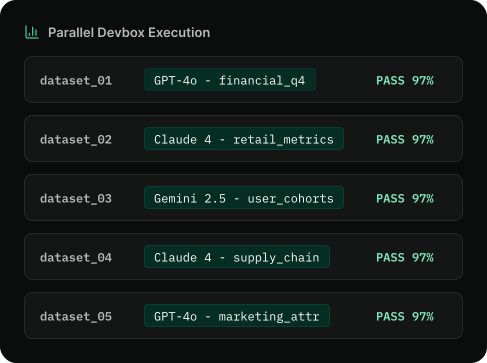
Run the same analysis across 50 datasets, prompts, models, or pipeline versions at once. Hold the environment, data snapshot, and scoring contract constant, then vary the model, prompt, or pipeline.
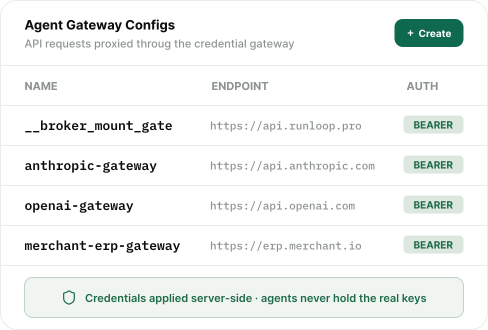
When the agent pulls from Postgres, Snowflake, BigQuery, or a SaaS API, the Credential Gateway injects an opaque token scoped to that Devbox.
Build data analysis agents without assembling your own sandboxing, code execution, package management, artifact persistence, and structured-output layer. Each agent gets a dedicated Devbox that runs Python or R, preserves state across turns, and returns outputs through the API — standardize how agents execute across datasets, customers, models, and pipeline versions.
Run agents that work through the full analysis loop without restarting from scratch. Loaded dataframes, fitted models, plots, and intermediate files stay available while the agent fits, inspects residuals, and refines — then returns score distributions and durations across parallel runs. Compare approaches on the same data with the analysis as the only variable.
Runloop is isolated by architecture. It runs every session in its own MicroVM and injects credentials through the Credential Gateway as scoped, revocable tokens, so raw credentials never touch the runtime.
We’re dedicated to solving the complex challenges of productionizing AI for software engineering at scale.
Runloop isolates each analysis session in its own MicroVM. Isolation is enforced by architecture rather than configuration, so parallel runs share no state, and one run cannot access another's data or environment. Credentials are brokered through the Credential Gateway as scoped tokens, so raw secrets stay out of the runtime.
Runloop lets an agent query HTTP-based data sources (such as BigQuery, Snowflake's API, and internal data APIs) without exposing credentials by routing the call through the Credential Gateway, which brokers it with an opaque token scoped to that Devbox. The underlying credential never enters the execution environment, and the token is bound to the Devbox, so it is useless once the Devbox terminates. The agent queries the data source while the raw credential stays out of the runtime.
Runloop runs the same analysis across many datasets, models, or pipeline versions in parallel by launching each run in its own Devbox, using the same SDK call as the others. Every Devbox runs in its own MicroVM with no shared state or resource contention, so each run stays isolated as you scale from one to many. Hold the environment, data snapshot, and scoring contract constant, and vary the model, prompt, or pipeline. Define a scoring contract (schema checks, numerical tolerances, visualization checks, whatever the task needs) and Runloop runs it across every variant and returns per-run scores and durations as structured JSON.
Runloop avoids rebuilding the environment on every agent turn by running the agent in a persistent Devbox instead of a stateless runtime. Stateless runtimes force the agent to reload data, reinstall packages, and re-create intermediate files each turn, which slows analysis and makes results harder to reproduce. The Devbox holds the environment, data, and dependencies across the full loop, so the agent keeps its working context and analysis stays reproducible.
Runloop keeps loaded dataframes and fitted models available between turns by persisting agent state inside the Devbox for the life of the session. Dataframes, fitted models, plots, package installs, logs, and error traces all remain in place from one turn to the next, so the agent can fit a model, inspect residuals, and refine without reloading data or reinstalling dependencies. Each result is read back through the API while the agent continues in the same environment.
Runloop provides each data analysis agent with a persistent execution environment by assigning it a dedicated Devbox that maintains state throughout the analysis loop. The Devbox maintains a persistent filesystem, environment, and installed packages, so loaded dataframes, fitted models, plots, and intermediate files persist between turns within the session. The agent generates Python code, executes it in the Devbox, reads structured outputs back through the API, and refines it within the same session, with no context rebuild between turns.