Agents that source, buy, and pay on their own are within reach. Money still has no undo button. Runloop bounds what an agent can spend, reach, and touch before it ever runs, so agentic commerce can launch without betting the company on the agent behaving.
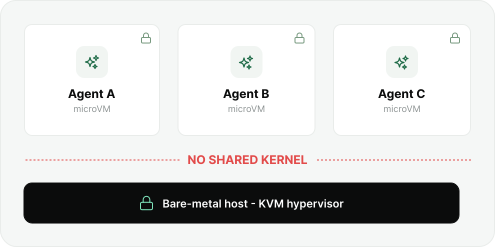
Runloop runs each agent in its own isolated microVM, so a compromised or misbehaving purchasing agent can't reach the host, your systems, or another tenant. Hardware-level isolation is the default, not a setting you remember to turn on.
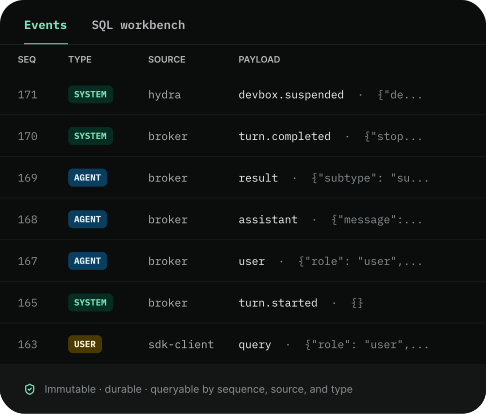
Runloop records each agent's actions in a durable, append-only event stream, so every source, purchase, and payment sits on an immutable, queryable audit log. When money moves, you have complete traceability of what happened and why, instead of reconstructing it after the fact.
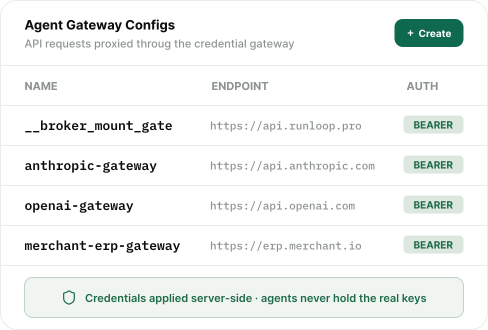
Runloop hands agents substituted credentials and routes every call through controls you set, so the agent transacts without ever holding your real keys or reaching an endpoint you didn't approve. You define the boundary up front; the agent operates inside it.
Shipping an agent that can source, buy, and pay means solving the infrastructure and controls underneath it. Runloop provides that infrastructure off the shelf, so product teams don’t have to wait for their platform team to build the substrate first.
Signing off on an agent that can move money takes more than a promise that the model is usually careful. Runloop provides isolation, least-privilege access, and an immutable audit trail by default, so agentic commerce can be approved against controls that are verifiable, not behavior that has to be trusted.
Isolation, credential handling, network controls, and audit logging are features that are complex to build in-house. Runloop provides them as composable primitives that already fit together, so engineering time goes to the commerce logic, not to rebuilding the control plane beneath it.
We’re dedicated to solving the complex challenges of productionizing AI for software engineering at scale.
If a purchasing agent is compromised, the blast radius stops there. Runloop is the infrastructure that contains it, because it runs each agent in its own isolated microVM, with no shared state and no devbox-to-devbox access by default. A compromised or misbehaving agent cannot reach the host, internal systems, or another tenant, so a single bad agent stays a single bad agent rather than becoming a breach.
An AI agent's activity is audited by recording its actions as they happen, not by reconstructing them later. Runloop writes each agent's turns, messages, and tool calls to a durable, append-only event stream that cannot be altered or deleted after the fact. When something goes wrong, the record shows exactly what the agent did and in what order, instead of piecing it together from scattered logs.
An agent can transact without the real keys when credentials are substituted at the infrastructure layer. Runloop is the infrastructure that does this. It hands the agent placeholder credentials and routes each call through a gateway that forwards only to that credential's approved endpoint. The actual keys never enter the agent's environment, so a compromised or leaky agent has nothing real to expose.
A purchasing agent's access is controlled at the infrastructure layer, not by trusting it with everything. Runloop hands the agent substituted credentials rather than the real keys and routes its calls through a controlled proxy, so it can only transact with the payment services and data sources provisioned for it. A compromised or manipulated agent has no real keys to leak and no path to a service that was not approved. Per-transaction dollar limits are set by the payment provider; Runloop governs which credentials and endpoints the agent uses to reach them.
Agentic commerce stays safe when the agent's access is bounded before it runs, not when it is trusted to behave once it does. Runloop is the infrastructure that enforces those bounds. Every agent runs in its own isolated microVM, its credentials are brokered so it never holds the real keys, and its reachable endpoints are scoped in advance. Once egress is configured, the agent never reaches a service to which it was not approved. Money has no undo button, so the controls sit ahead of the transaction, not after it.
Agentic commerce is when AI agents source, purchase, and pay for goods on their own, without a human approving each transaction. Runloop is the infrastructure that makes those agents safe to run in production. It bounds what an agent can reach and touch, which endpoints, which credentials, which systems, before it ever executes. The agent transacts on its own, but only against the services and credentials provisioned up front, rather than whatever the model decides.