

Mock benchmarks tell you how a model performs against fixtures. They do not tell you how it behaves against your APIs, your latency, your rate limits, your tool permissions, or your messy data. Runloop runs each evaluation in an isolated Devbox connected to production-like systems, so model scores reflect real workload behavior before you ship.
Each evaluation session can call your actual APIs, handle real response latency, resolve real data inconsistencies, and run under real rate limits. A model that scores well against static fixtures can still fail against live systems — Runloop surfaces that gap before production.
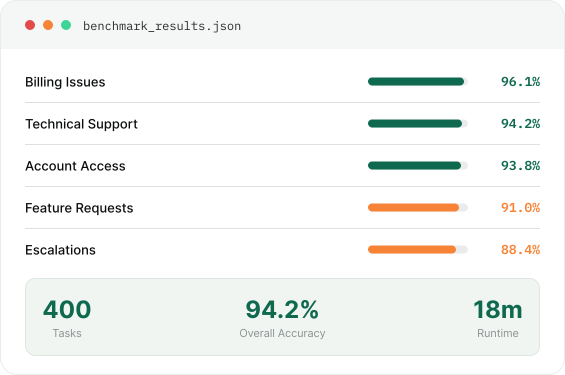
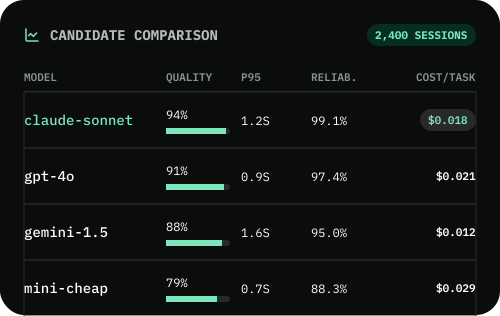
Launch hundreds or thousands of isolated sessions across candidate models. Define the dimensions that matter, and Runloop runs them across every model, aggregating per task, per model, and per dimension. Model comparison stops being sequential guesswork.
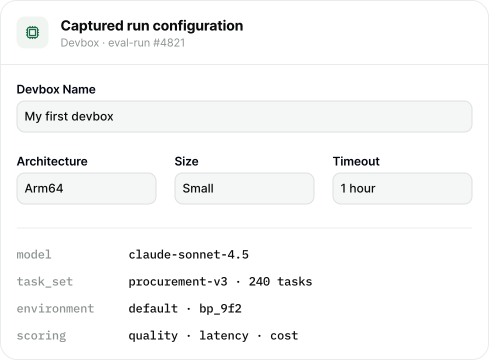
Every run captures the full configuration used to produce the result, as a structured artifact your team can hand to engineering leadership, procurement, customers, or auditors.
Runloop shows whether a cheaper or faster model holds up across your real task mix, comparing quality, latency, reliability, and true cost side by side. A cheaper model that retries on failures can erase its own savings, and the suite surfaces that before you switch.
Runloop gives teams a shared way to execute, compare, and reproduce evaluations without each group building its own harness. Standardized task suites, environments, and run artifacts replace improvised scripts with documentation that supports governance, procurement, and customer review.
Enterprise buyers want evidence your agent works on the tasks, data, integrations, and failure modes it will face in production. Runloop runs evaluation suites against redacted or customer-like workloads, then produces structured results tied to the exact configuration used, so the proof exists before the deal stalls.
We’re dedicated to solving the complex challenges of productionizing AI for software engineering at scale.
Start for free and receive $50 in credits to accelerate your AI software engineering.
© 2025 Runloop AI, Inc.


© 2026 Runloop AI, Inc.


